Few materials combine density, strength, and heat resistance as effectively as tungsten. As a refractory metal, tungsten is exceptionally resistant to wear. Additionally, tungsten has the highest melting point of all elements, making it ideal for high-temperature applications. In today's medical cable assemblies, tungsten cables are the premier choice due to their material properties, strength-to-flexibility ratio, and durability in lifecycle testing.


Material Makeup of Tungsten Cable
Density
Tungsten has a density of approximately 19.25 g/cm³ (grams per cubic centimeter), about 1.7 times that of lead. Because of this density, tungsten cables can hold application-specific load requirements at very small diameters. Strength at such small diameters is vital for supporting the miniature mechanical systems used in today's Medtech devices.
Additionally, tungsten's high density makes it effective at radiation shielding. For instance, tungsten cable is a common component found in the “heads” of CT scanners because its density allows for about a 40% reduction in radiation volume. Medical devices such as stents, catheters, and guide wires need to be visible under X-rays. Tungsten’s density enhances visibility, helping surgeons accurately position these devices within the human body.
Tensile Strength
Tensile strength is the maximum stress a material can withstand when pulled or stretched before breaking. Tungsten is the strongest natural metal, with a tensile strength of 142,000 psi. Because these cables are subject to mechanical stress, tensile strength is a design consideration for cable assemblies used in robotic surgery and endoscopic tools.
As diameters decrease, strength typically decreases as well. MedTech engineers face this challenge when designing miniature cable assemblies. Tungsten helps offset this limitation. Its high tensile strength allows very small cable constructions to withstand the tight bending radii imposed by miniature pulleys commonly used in medical devices.


Low Coefficient of Stretch
Elastic stretch, similar to that of a rubber band, returns to its original shape, while constructional stretch does not. During cable production, air pockets can form, and pulling on the cable can reduce constructional stretch. When cables are threaded through a pulley, stainless steel cables exhibit some stretch, whereas tungsten cables do not.
In MedTech environments, a computer will translate the surgeon's hand movements into cable tension. If a cable stretches, there may be a delay or "backlash" between the command issued and the instrument's response.
The stiffness of tungsten ensures that the instrument tip reacts immediately. Instruments must be calibrated to a home position; however, cables with a high coefficient of stretch require frequent recalibration because they "creep" over time. By using tungsten, this issue can be minimized, which extends the lifespan of the instrument.
High Temperature
Tungsten has the highest melting point of all metals, reaching an impressive 6,192°F. To put this into perspective, tungsten is about 2.5 times more heat-resistant than stainless steel. While most metals experience a significant drop in tensile strength at temperatures above 900°F, tungsten retains considerable strength even at high temperatures.
Medical cables, which are often reused, must endure hundreds of sterilization cycles, and tungsten’s stability remains unaffected by these high heat levels. This high-temperature resistance is crucial for electrosurgical tools that need to maintain rigidity during cauterization, as well as for robotic actuators that require precise calibration after repeated autoclave cycles.
Additionally, tungsten's thermal resilience, coupled with its low coefficient of thermal expansion, makes it an ideal choice for high-heat diagnostic environments such as X-ray anodes and CT scanners, where material failure simply cannot occur.
Whether it's a Prototype or Production Run...
Trust Sava's 50+ Years of Cable Expertise
Lifecycle Testing & Strength-to-diameter Ratio
Lifecycle testing of tungsten cable plays a significant role in the evaluation and reliability of medical cable assemblies. During testing, tungsten cables have demonstrated their ability to withstand millions of cycles over tight bending radii, sometimes as small as the tip of a crayon, without losing structural integrity. This "deadness" or lack of internal tension allows tungsten to move smoothly and predictably, ensuring that delicate surgical instruments remain precise even after repeated use.


The superior lifecycle of tungsten is mainly due to its hardness and thermal resistance. Tungsten’s capacity to retain its original breaking strength throughout its lifespan makes it ideal for high-performance surgical robotics. By enduring harsh sterilization cycles and continuous mechanical stress with minimal degradation, tungsten provides the long-term reliability necessary for modern cable assemblies to perform well.
The performance of these cables primarily depends on their construction, specifically the balance between wire count and tensile strength. For example, the 19x37 construction uses 703 individual filaments to provide the highest possible flexibility for complex robotic movements. In contrast, constructions like the 8x19 utilize fewer, thicker wires to achieve higher breaking strength and stiffness. By selecting the right configuration, whether it is the highly flexible 19x19 or the more robust 7x37, engineers can create medical cable assemblies that offer the ideal blend of strength and range of motion.
Ultimately, the effectiveness of a tungsten cable is determined by various factors working together. A bundle of many fine tungsten wires creates a flexible, easy-to-move cable, while using fewer and thicker tungsten filaments yields a more rigid cable that can withstand tight loops without wearing out. Therefore, the strength of a tungsten cable is not solely about the size of the wires or the metal itself. It results from how the diameter, wire count, and overall construction are matched to the specific requirements of the job the cable needs to perform.
Types of Tungsten Cable
Sava manufactures two types of tungsten cables for medical use: bright and black. The terms “bright” and black” describe the surface finish of the wire.
Bright (ElectroPolished) Tungsten Wire
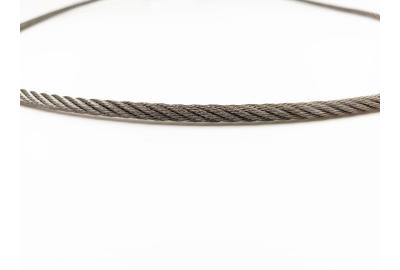
The black wire undergoes alkali washing or electrolytic polishing, which strips away graphite and oxides. This process reveals a shiny, silver-metallic surface of tungsten. The primary advantage of this treatment is that it results in an ultra-clean and smoother surface. This reduction in friction at a microscopic level ensures that no foreign particles, such as graphite, are introduced into a sterile environment. This standard is widely used in Medtech applications, including surgical robotics, neural probes, and catheters. The material is biocompatible and safe for medical use.
Want to see more?
Shop All Tungsten Cable →


Black Tungsten Wire
The wire retains a thin layer of graphite lubricant from the manufacturing process, which gives it a black appearance. It’s often used in the MedTech field, but typically only when biocompatibility isn't required. A common application for black tungsten wire is in end effectors of surgical robots. In this case, the wire is sealed and does not come in contact with patients or exist in a sterile environment. The advantages of using black tungsten wire include its lower cost due to the absence of electropolishing and the natural lubrication provided by the graphite, which can contribute to a longer shelf life.
Want to see more?
Shop All Tungsten Cable →


Why Tungsten is a Perfect Fit for Surgical Robots
Modern surgical robotics relies on miniature cable assemblies to replicate complex, human-like movements with precision. Tungsten is an ideal material for these instruments because it combines high tensile strength with the flexibility and wear resistance needed to manage heavy loads and navigate tight radii. This ensures that the cables maintain their reliability and performance during demanding surgical procedures.
Thanks to its ability to withstand mechanical stress, tungsten contributes to quicker and safer surgical procedures without compromising patient safety. Additionally, its natural corrosion resistance, enhanced by a protective black finish, makes it well-suited for the sterile, climate-controlled environments of operating rooms, ensuring long-term reliability and performance.
Practical Applications
Beyond the world of robotics, tungsten's unique properties make it versatile across a wide spectrum of medical applications. Its high density and resistance to extreme conditions make it an ideal choice for everything from syringe protection and X-ray shielding to the sensitive components within CT scanners. Whether used in therapy delivery systems or general manual instruments, tungsten’s reliability ensures that medical equipment remains durable and precise, ultimately providing a higher standard of care throughout the entire medical field.
- Syringe Protection Equipment
- Medical Cable and Cable-actuated Tools
- Sensitive Medical Transportation Containers
- Therapy and Treatment Delivery Machinery
- Refractory Metal
- Shielding Layers and Insulation
- X-ray & CT scanner systems
- Radiation therapy delivery systems,
- Mobile Shielding
- General Medical Manual Instruments.
Trusted for over 5 decades, Carl Stahl Sava Industries provides world-class mechanical cable assemblies for a range of industries using tungsten, as well as 302, 304 stainless steel, nitinol, and a host of other materials. For projects requiring tungsten cable or any other complex requirements, contact a cable expert at Sava today.